

Features
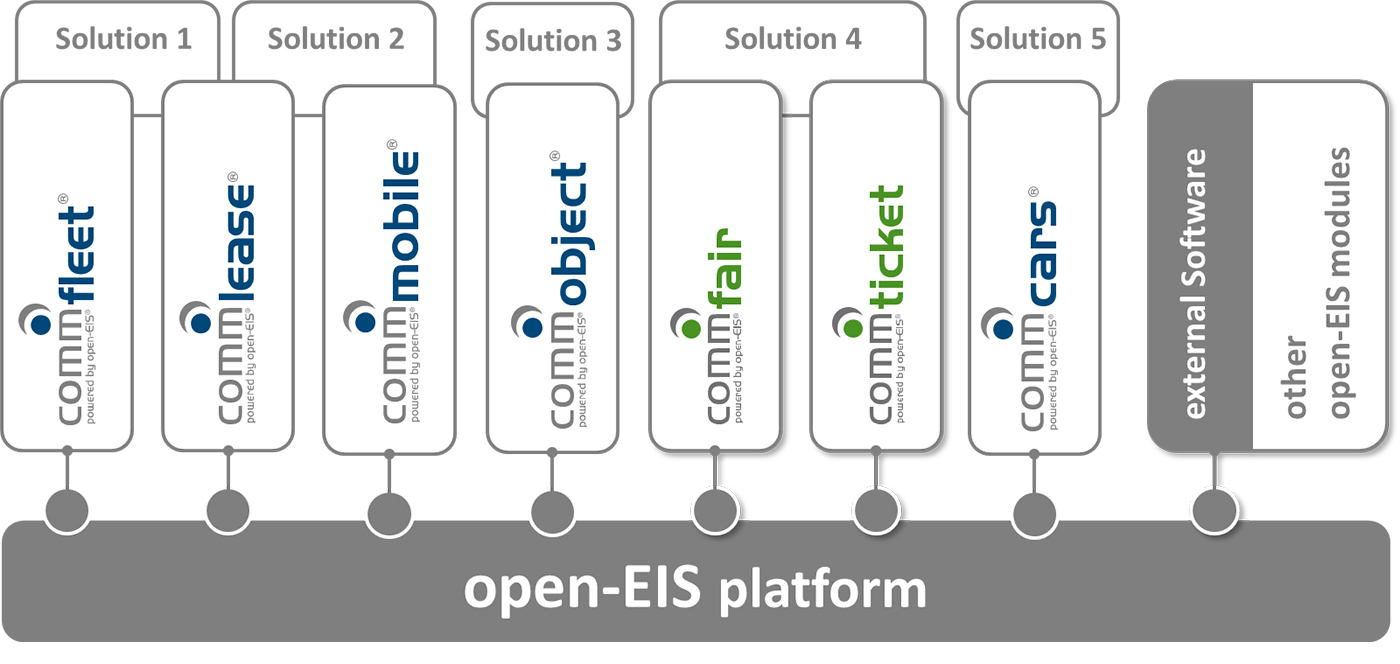
The open-EIS platform comprises the following basic criteria:
- Permissions management
- Search
- Dynamic data technology
- Multilingualism
- Security/ encryption
- Data replication and interfaces to third-party systems
- Print-on-demand
- System scalability and resilence
- XML support and XML/CSV-based data representation
Permissions Management
Access authorization for specific information is carried out by content categorization. Configuration of visibility and editing rights according to easy rules allows for the modeling of complex right and workflow scenarios. A process-oriented permission customization can be performed for different user groups via multiple allocation of information units into parallel categories. The open-EIS right system enables the personalization of all elements on the basis of group roles and user levels and can be applied to the user interface, to the information visibility, as well as to the functionalities for the editing of information.
Search
- Hierarchical: The search is carried out according to a hierarchical category structure similar to the typical folder organization of Windows and other operating systems. Hereby, the allocation of information to a user-defined number of categories allows for a successful content retrieval over multiple paths.
- Structured: Via configurable search masks selection boxes are offered for the search. Choice boxes can be preallocated with defined values. Within the search fields placeholders can be used. The combination of several search criteria is possible. Diverse entry masks can be configured with respect to the information structure.
- Full Text: Via the integrated full text search all documents can be searched. Presently, also the following attached files are indexed by the full text search: office documents (Word, Excel, Powerpoint) as well as PDF, TXT, HTML.
Dynamic Data Technology
The dynamic data technology (DDT) was patented and is a method for saving, securing, archiving and organizing data, administrating and mapping structures, access administration, work flow management and data exchange.
The most important advantage of the technology are the "self-describing" information structures. By default integrated in the data model are the possibility of personalization (flexible role, group and user-based rights management), multilingualism and regionalization. In addition, the system supports the easy linking of existing applications and at the same time quick access. The DDT unites the advantages of existing technologies such as SQL or XML and extends those by functionalities missing so far.
The new technology qualifies for the administration of documents as well as for the complete structures of Internet services (especially content management systems/ authoring systems i.e. for WWW-sites) and for the flexible steering and monitoring of production systems; and also for Application Service Providing (ASP), which is gaining in importance. DDT is characterized by the structural independence from specific repository systems. The standardized XML/DTD interface supports the remote data transfer and synchronization with conflict resolution based on a global unique identification; special import and export filters for information are no longer necessary.
Multilingualism
All information can be edited and used in any language. The administration and configuration of languages relies on a system-wide Unicode support, which permits the use of all international characters, including multi-byte (i.e. Chinese) characters. The seamless integration of foreign employees, clients, partners and subsidiaries is thus assured.
Data sets can be generated in any language at the time of creation or later. Changing the languages individually by the user is possible at any time. Separated languages for the user interface and the content management can be set up. In this way, Chinese translations can be edited via copy & paste with the German user interface.
Users can access information from all sources in the desired language.
Security/ Encryption
The access to open-EIS is controlled by standard and well-established security protocols. SSL/TLS is utilized by default for Internet browser access, recognizable through the "https" protocol in the URL. The data is transferred in encrypted form between the user and the server. The use of security certificates on the side of the server is possible without any problem. The data exchange between different systems, for instance during replication, is carried out by SSH protocol, thus providing an automatic encryption layer. The transfer protocol can be replaced transparently.
Data Replication and Interfaces to Third-party Systems
open-EIS disposes of an independent replication layer, which is located above the data abstraction tier. Therefore, the replication is carried out independently from the concrete database technology. Full as well as incremental replication is available and supported by an internal document log, which records all changes to documents and content elements. The configuration of the content to be replicated can be based on the following criteria:
- content categorization;
- content meta data such as the author or the process status, for example;
- Global Unique Identification (GUID), assigned uniquely to each document in open-EIS
Print-on-Demand
Users can select diverse information in a personalized way and receive respectively print out compiled information in PDF format. This individual result can be saved and is at disposal as needed. The deposit of layout templates ensures a company-wide uniform layout of all print media. Solutions such as online tickets, personalized catalogues, pre-completed order forms or automatic document generation for different output channels can be realized with open-EIS' print-on-demand function. This function is able to reproduce linked information structures from different kinds of information automatically.
System Scalability and Resilience
Different options and scenarios for scalability and system resilience are supported on the basis of the open-EIS architecture and the replication layer. For scalability and security reasons the database, the application and the WWW layer can be operated on different servers (i.e. on different DMZ) thanks of the multilevel Java architecture. Furthermore, central server clusters can be operated by open-EIS systems, from which single systems, for example during software updates, can be dynamically removed and reactivated. You can also work with decentralized systems in your subsidiaries and thus achieve maximum local access speed for your branch staff. Hereby, the decentralized open-EIS systems can run on different operating systems with diverse database servers.
XML Support and XML/CSV-based Data Representation
- Automatic media type recognition and MIME-type allocation
- Import of any kind of media data
- Import of structured documents (from data banks, XML etc.)
- Import of Office formats (MS Office, Corel Office, Framemaker etc.)
- Possibility of tying any kind of filter
- Module interfaces
- Replication/ export

